Winning customer trust with professional service!
 Learn More About JIMU
Learn More About JIMU
Learn More About JIMU

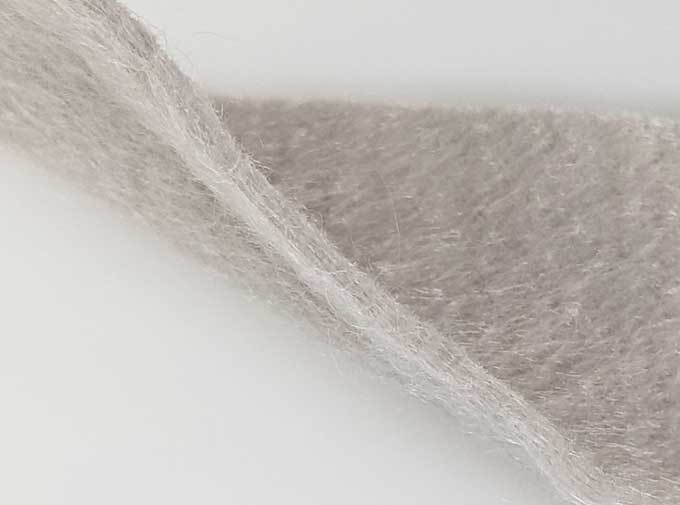
The density of polypropylene fiber is only 0.91 g/m3 (that of polyester fiber is 1.38 g/m3), so polypropylene geotextile has larger coverage area under the same strength when using as polyester geotextile.
Installation Instructions
1) Prepare the project area by removing stumps, rocks, and other objects that could puncture the fabric or keep it from filtering properly.
2) Smooth and level the installment area.
3) Place the non woven polypropylene fabric on the ground, overlapping at 12-18.
4) Secure the fabric using staples or similar, especially around edges and overlaps.
5) Backfill over the fabric to at least 6 depth. Poor ground soils may require a deeper backfill.
Soil stabilization
Adds strength and support to locations with poor soil quality or sloping gradients.
Erosion and sediment control
Provides results in protecting slopes, banks and hillsides from the effects of erosion, and has strong soil retention properties.
Underlayment
Reinforces jobsites while providing a uniform and tear resistant underlayment layer for road and driveway construction projects. Using non woven polypropylene fabric as an underlayment will prolong the life of your driveway or road.
Drainage and filtration
Filters sediment while letting stormwater pass through.
Gasoline filtration
Filters gasoline effectively with its 50 sieve rating.
●The density of polypropylene fiber is only 0.91 g/m3 (that of polyester fiber is 1.38 g/m3), so polypropylene geotextile has larger coverage area under the same strength when using as polyester geotextile.
●Due to the small surface friction coefficient of polypropylene fiber, the friction between fibers is small, the wear resistance is good, and the anti-vibration friction performance is far better than that of polyester fiber.
●Polypropylene fiber has good hydrophobicity and does not absorb water, so it is better than polyester fiber for water supply and drainage engineering.
●Compared with polyester geotextile with the same weight, high-performance polypropylene non-woven geo-
●textile has more fibers and higher strength, and its longitudinal and transverse strengths are almost the same.
●The special structure of polypropylene fiber makes it have excellent acid and alkali resistance, especially its alkali resistance is better than that of polyester fiber, and its effect is better than that of polyester fiber when it is in the reinforcement, waterproof, anti-seepage applications in underground engineering works with strong acid and alkali environment.

© 2021JIMUAll Rights Reserved. We are looking forward to hearing from you soon.
No. 1109, 11th Floor, 8# Building, 388# Yizhou Avenue North Section, Chengdu High-tech Zone
蜀ICP备2024081136号-1


